A Quiet Question
Why did your parents spend time raising you?
Not just providing. Not just earning for you.
But being there — present, watching, guiding, correcting, teaching, sharing moments, sharing meals, sharing work.
What were they really passing on?
Only food and a roof?
Or were they also passing on something quieter — habits, values, the way to hold themselves through life's difficulties, the way to speak to others, the way to think about responsibility?
And their parents before them — why did they invest years in raising their children?
It seems that every generation, across all time, has understood one quiet truth:
💭 Children do not raise themselves.
What Does It Mean to "Raise" a Child?
Is it enough to provide education, food, clothing, and a comfortable home?
Those are essential, yes.
But are they complete?
Or is there something more — something that cannot be bought, something that cannot be outsourced?
Raising may also mean:
- Being present in the same room, not just in the same house
- Watching how a child thinks, reacts, behaves
- Sharing conversations that have no agenda
- Working together on ordinary tasks
- Allowing them to observe how adults handle daily life
- Teaching patience, not by lecture, but by living it
These cannot be delegated.
They cannot happen remotely.
They require time. Attention. Presence.
Are we raising our children — or are we simply managing their schedules?
Where Is Our Attention Going?
This is not about judgment.
This is simply about noticing.
In a typical evening at home, where is your attention?
On your phone?
On work emails that arrived after work hours?
On social media scrolling?
On entertainment — shows, videos, news, sports updates?
Or with your children — their words, their questions, their presence?
There is no right answer here. Only an honest one.
💭 If we observed our own attention for one week, what pattern would emerge?
And could some of that attention — not all of it, but some — quietly return home?
Provision Is Important — But Is It Enough?
We work hard. We earn. We pay for education, health, safety, comfort.
That effort is valuable.
But years from now, when your child looks back at their childhood, what will they remember?
The tuition fees you paid?
Or the evenings you sat together?
The expensive gifts you bought?
Or the simple meals you cooked together?
The money you saved in their name?
Or the way you listened when they spoke?
Do children remember what parents earned — or what parents gave attention to?
Provision is necessary.
But perhaps it is not sufficient.
Perhaps raising also requires being there — fully, repeatedly, without distraction.
What Happens When We Work Together?
Think about the activities that happen at home, almost invisibly, every single day:
Cooking. Cleaning. Planning. Organizing. Repairing. Tending to the space.
Who does these tasks in your home?
Are children involved?
Or are they kept separate — protected from what might feel like "work"?
What if those ordinary tasks are not interruptions to childhood — but opportunities?
- Cooking together teaches patience, planning, care
- Cleaning together teaches responsibility, discipline, contribution
- Planning together teaches decision-making, priority, delayed gratification
- Fixing things together teaches problem-solving, persistence, resourcefulness
None of this requires extra time or money.
It only requires invitation.
💭 Could the simplest household activities become the most powerful education?
Because when children participate in the daily running of a home, they do not just learn tasks.
They learn that they belong. That their contribution matters. That they are capable.
What Are Children Really Learning From Us?
Here is something uncomfortable but true:
Children do not become what we tell them to become.
They become what they observe — day after day, year after year.
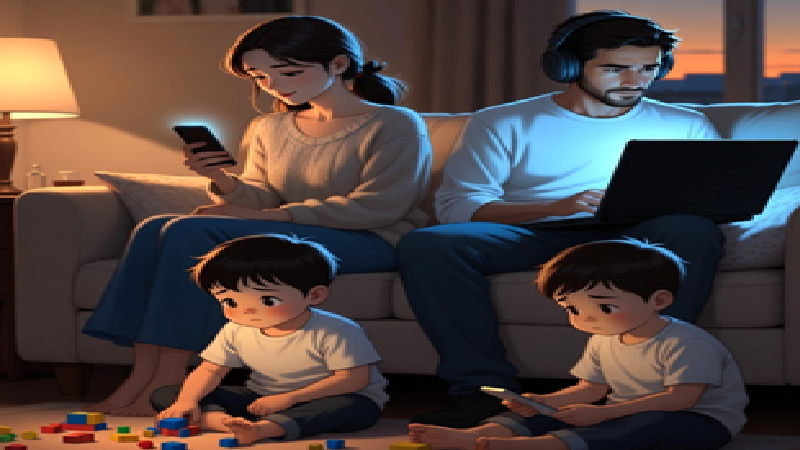
If we spend hours on a screen, they learn that screens deserve hours.
If we scroll endlessly, they learn that restlessness is normal.
If we react impulsively, they learn that patience is optional.
If we avoid difficult conversations, they learn that silence is safer than honesty.
If our attention lives inside a screen, where will theirs live?
Children are not learning attention from a book.
They are learning it from watching where ours goes.
Every. Single. Day.
What Patterns Are Traveling Across Generations?
Take a moment to imagine:
Twenty years from now, your child becomes a parent.
What kind of parent will they be?
Will they sit with their children — or sit beside them, distracted by a device?
Will they cook with their children — or order food while their children watch videos?
Will they listen when their children speak — or half-listen while scrolling?
This is not speculation.
This is pattern repetition.
💭 Children often become the kind of parents they experienced — not the kind they were told to become.
So perhaps the question is not only about today.
Perhaps it is also about the next generation. And the one after that.
What are we quietly passing on?
What Do Present Parents Quietly Offer?
When a parent is truly present — not just physically in the house, but mentally, emotionally available — what might a child receive?
- A sense of being seen, heard, valued
- Confidence — not from praise, but from participation
- Practical life skills learned through shared activity
- Emotional steadiness — knowing that someone is truly there
- Healthy daily routines modeled naturally
- The understanding that relationships require attention, not just coexistence
These are not taught in a classroom.
They are absorbed at home.
Slowly. Silently. Powerfully.
What Does This Have to Do With Living 100 or 120 Years?
A life that reaches 100 or 120 years may not depend only on food, exercise, or medical care.
It may also depend on:
- Strong, meaningful family relationships
- Daily habits formed early and maintained across decades
- Emotional stability built in childhood
- The ability to live independently — to cook, to care for oneself, to remain active
- Deep human connection, not digital substitutes
These foundations are not created at 40 or 50.
They begin in childhood.
And they may determine not just how long a child lives — but how well they live across those many years.
Perhaps children do not become healthier only because of medicine. Perhaps they become healthier because of the life they experience every day at home.
What Are We Really Handing to the Next Generation?
As adults, we have a quiet responsibility.
Not to be perfect.
Not to never make mistakes.
But to be aware.
To notice where our attention goes.
To see what patterns we are modeling.
To ask, gently and honestly:
💭 Are we raising our children — or are we only living in the same house while our attention is somewhere else?
Because children grow in the direction of their parents' attention.
Not where parents say to go.
But where parents are already looking.
A Moment to Sit With
If your child remembers this stage of life twenty years from now, what moments will come to mind first?
The devices you both held?
Or the moments you shared?
The schedules you managed?
Or the conversations you had?
The things you bought them?
Or the time you gave them?
If your children inherit your attention habits, what kind of parents will they become?
There is no blame in this reflection.
Only an invitation to pause. To notice. To consider.
Because perhaps raising children is not a list of tasks to complete.
Perhaps it is a presence to maintain.
Day after ordinary day.
A Final Thought
🌿 Why not 100?
Why not 120?
Perhaps it begins…
with giving our best attention to the people growing beside us.
— Why Not 100 Movement 🌿