Have you imagined yourself at 90, still being present for your children?
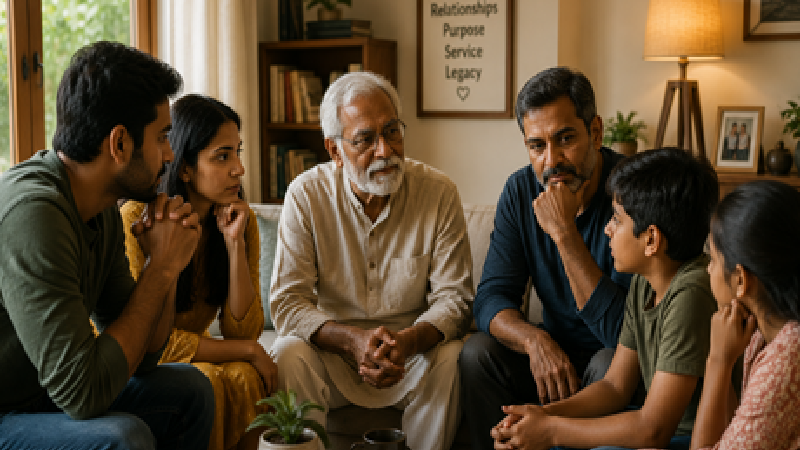
As a parent, have you ever paused to consider the possibility that you and your children may live 100, perhaps even 120 years?
Not as medical prediction. Not as guarantee.
Simply as a long horizon worth thinking about.
And if that became possible — if life truly stretched that far — have you thought about what those additional years might be for?
Is long life only about staying alive?
Or might there be something more quietly meaningful waiting in those later decades?
When your child is 50, will you still be needed?
Think about the arc of a human life.
When children are young, they need their parents for almost everything — food, shelter, safety, guidance, decisions.
But as they grow, that dependence shifts. They learn to stand on their own. They make their own choices. They face the world directly.
And at some point, many parents assume: They don't need me anymore.
But is that entirely true?
When your child is 30, 40, or 50 — facing the weight of raising their own children, navigating broken relationships, managing financial pressure, confronting unexpected health challenges, or simply feeling lost in a world that moves too fast —
Will they stop needing you entirely?
Or will the need simply change?
They may no longer need you to make decisions for them. But might they still need someone who listens without judgment? Someone who has survived similar seasons? Someone who remains steady when everything else shakes?
A world becoming faster, more complex, more uncertain
The world your children will navigate in their adult years may be unlike anything previous generations faced.
Consider what lies ahead:
- Careers disrupted by technology and artificial intelligence
- Economic uncertainty and financial complexity
- Relationship challenges in a hyperconnected yet isolated world
- Information overload that never stops
- Social comparison across digital platforms
- Health pressures from modern lifestyles
- The profound responsibility of raising children in unpredictable times
In the middle of all this complexity, who offers perspective?
Who helps them see the longer horizon when everything feels urgent and overwhelming?
Can every life question be answered by a search engine, an app, or a stranger online?
Or are there moments when a familiar, calm, mature human presence matters differently?
What can an elder offer that technology cannot?
This is not about positioning technology as the enemy.
Machines can provide information, solutions, efficiency. They have their place.
But lived wisdom is not the same as data.
Perspective is not the same as answers.
Calmness is not something you download.
When someone you love faces the hardest season of their life — when nothing makes sense and every path feels uncertain —
What do they truly need?
- Someone who has already walked through similar uncertainty and emerged steady
- Someone who can sit beside them without needing to fix everything immediately
- Someone who listens deeply before speaking
- Someone whose very presence reassures: You can survive this. I have seen it before.
Perhaps that kind of presence cannot be replicated by anything other than a human who has lived long enough to embody it.
Guidance without control — a critical distinction
To be clear: this is not about controlling your children's lives.
This is not about making their decisions for them.
This is not about treating younger generations as incapable or weak.
An elder's role is not to command.
It may be to:
- Listen before speaking
- Guide without overpowering
- Support without deciding everything
- Ask questions that restore clarity
- Remain available without interfering unnecessarily
- Stand nearby during uncertainty — not leading, but accompanying
The difference between guidance and control is respect.
Respecting that your children are adults. Respecting their agency. Respecting their journey.
And yet — being there when they need a hand to hold.
What if the most valuable thing you could offer your children later in life is not advice — but simply the calm certainty that someone who loves them is still here, still available, still steady?
What are the foundations children may need to return to?
Life has a way of pulling people away from healthy foundations.
The pressures of modern life — work, speed, distraction, comparison, consumption — can slowly erode what matters most.
Basic habits. Simple rhythms. Core practices.
Things like:
- Caring for health — moving the body, eating real food, resting properly
- Managing money responsibly — saving, spending carefully, avoiding unnecessary debt
- Maintaining relationships — showing up, listening, keeping promises
- Emotional steadiness — pausing before reacting, choosing calm over chaos
- Taking responsibility for daily life — not outsourcing everything, not avoiding difficulty
When someone drifts far from these foundations, who can gently help them see the way back?
Not through lectures. Not through criticism.
But through lived example. Through presence. Through someone who has remained anchored to those foundations across decades.
Perhaps that is one quiet reason why living elders matter.
If you hope to remain useful at 80 or 100, what are you building today?
Here is where the reflection turns inward.
If you hope to be present and capable for your children and grandchildren in later life, what habits are being formed today?
To remain useful at 80, 90, or 100 may require more than luck.
It may require:
- Physical activity — keeping the body capable of participation
- Simple food habits — eating in ways that nourish rather than harm
- Emotional regulation — learning to respond rather than react
- Financial responsibility — living within means, avoiding unnecessary burden
- Deep family connection — maintaining bonds across time and distance
- Mental engagement — staying curious, learning, thinking
- Self-discipline — doing what matters even when no one is watching
- The ability to listen — truly hearing without rushing to judgment
These habits are not built overnight.
They are built slowly, quietly, over decades.
What you practise at home today may determine whether you are capable of standing beside your grandchildren 40 years from now.
Children learn the possibility of long life by seeing it
Here is something worth considering.
If your children never see an elder who remains healthy, active, calm, and mentally sharp into their 80s or 90s —
How will they imagine that possibility for themselves?
If ageing, in their experience, means only decline, illness, dependence, and loss —
Will they prepare for strong and purposeful later years?
Or will they unconsciously accept that life after 60 is simply waiting for the end?
But if they see elders who remain engaged, useful, steady, and full of life well into their 90s or beyond —
What belief about ageing might they inherit?
Perhaps the way you age — the way you care for yourself, remain present, stay engaged, and continue growing — teaches your children more about longevity than any book or lecture ever could.
What might make a long life truly useful?
Living 100 or 120 years is not simply about avoiding illness.
It is not only about staying alive.
Perhaps longevity becomes meaningful when it offers something beyond the individual.
When those additional years become:
- A body capable of participation — not frail, not dependent, but active
- A mind that remains open — curious, learning, thinking clearly
- A calm presence during uncertainty — steady when others are shaken
- Wisdom shared without control — guiding gently, not imposing
- Relationships protected across decades — family bonds held together
- Willingness to keep growing — not becoming rigid, bitter, or closed
- A living bridge between generations — carrying memory, perspective, continuity
Perhaps long life becomes most meaningful when it serves more than just yourself.
When your presence at 90 becomes a quiet blessing for someone facing the hardest moment of their life.
A reason to remain present
Here is a question worth sitting with.
What if one of the deepest reasons to live a long, healthy life is not for yourself —
But for those who will need your calmness, your perspective, your steady presence later?
Your child at 50, facing the collapse of everything they built.
Your grandchild at 30, overwhelmed by the complexity of modern life.
Your great-grandchild, growing up in a world you cannot yet imagine —
Who may simply need to know that someone who loves them is still here, still steady, still available.
Perhaps longevity is not only about adding years to your life.
Perhaps it is about adding continuity, stability, and lived wisdom to the lives of those who come after you.
Think about it:
If your child faces their hardest season of life at 50, would your presence at 80 still matter?
If you hope to guide future generations later, what kind of parent and human are you becoming today?
If living to 120 became possible, what would make those years truly useful?
Long life as service, continuity, and blessing
This is not about creating fear around ageing or death.
This is not about treating younger generations as weak or incapable.
This is not about forcing children to follow elders.
This is simply a reflection.
A question placed before you like a mirror.
If you lived 100 or 120 years — healthy, capable, calm, present —
Who might need you to be there?
What might those years offer that goes beyond your own survival?
Perhaps the meaning of a long life is found not in the number of years, but in what those years make possible for others.
Perhaps healthy ageing is not vanity or fear —
But one of the most profound forms of generational responsibility.
To remain available.
To offer perspective.
To stand nearby during uncertainty.
To help someone return to healthy foundations when life pulls them away.
To be living proof that a human can age with grace, strength, and purpose.
Why not 100?
Why not 120?
Perhaps not only to live longer…
Perhaps to remain present when the next generation needs us most. 🌿