You did not begin with yourself
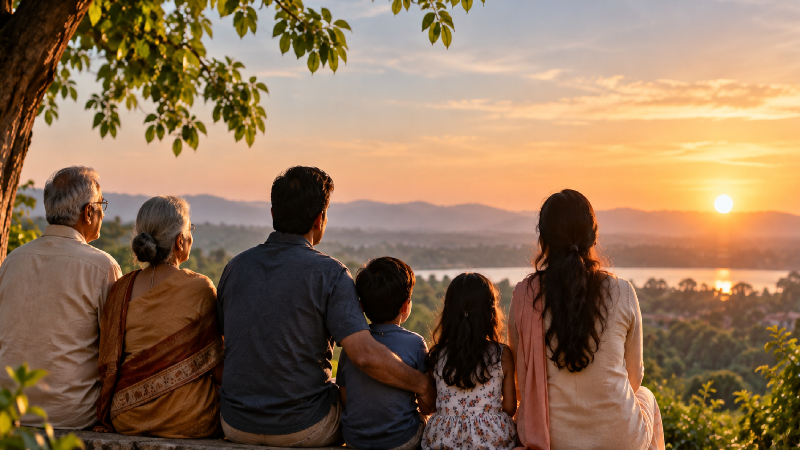
You have parents.
They had parents.
Their parents had parents.
Go backwards for a moment.
How many lives existed before yours? How many people worked, struggled, learned, made mistakes, cared for someone, and raised children before you arrived?
Now turn around.
Perhaps you have children. Perhaps one day they will have children. Perhaps those children will have children.
You are you. But are you only you?
You have your own life, choices, hopes and individuality.
And still, you arrived inside a chain that began long before you.
Could both things be true?
What reached you?
When you look behind you, what do you see?
Perhaps land. Money. A home. Stories. A language. Opportunities.
Perhaps difficulties. Debts. Fear. Silence. A way of speaking when problems arrive.
Perhaps you received ways of cooking, working, caring for elders, spending money, handling illness, using time, or thinking about old age.
Not everything was formally taught.
Some things may have been observed. Some repeated. Some adapted. Some rejected. Some may have entered your life so quietly that you noticed them only years later.
Were the people before you always right? Were they always wrong?
What reached you? What ended with them? What changed because it passed through you?
Now look in front of you
Your child is a child today.
But will that always be true?
One day, could this child become an adult, a worker, a partner, a parent, or even a grandparent?
When you look at your child, are you seeing only today's child? Or are you also seeing one of the future links in the same chain?
What might travel from your life into theirs?
Not through certainty. Not through a formula.
Simply through living together, watching, learning, remembering, questioning and choosing what feels worth carrying forward.
What passes without anyone teaching it?
Did your parents formally teach you every habit you have?
Or did you watch how food was prepared?
How money was discussed?
How adults spoke to one another?
How people reacted when difficulty arrived?
How evenings were spent?
How elders were treated?
What happened when something became boring, difficult or repetitive?
Now what are children seeing in us?
No guilt. No accusation.
Just observation.
The things that look boring
Why are some useful things so repetitive?
Cooking again.
Cleaning again.
Walking again.
Working again.
Learning again.
Taking care of the home again.
Listening again.
Saving again.
Showing up again.
Yesterday it was done. Today it appears again. Tomorrow, perhaps again.
Nothing viral. Nothing dramatic. Nobody applauds.
Could some of the things that matter across decades look surprisingly boring on an ordinary Tuesday?
What happens when something useful stops being exciting?
When the first motivation disappears? When nobody notices? When results are not immediately visible?
Does the value of an action disappear simply because the excitement has gone?
Could some things become meaningful because they are repeated long after novelty has gone?
What did your parents repeat?
What did your parents do repeatedly that you barely noticed as a child?
Cook? Work? Clean? Travel to work? Pay bills? Care for elders? Maintain a home? Keep family relationships alive?
Perhaps some of those repetitions helped you. Perhaps some did not. Perhaps today you understand some of them differently.
What are you repeating now that your children may understand only twenty years from now?
Could a long life be made of ordinary days?
If someone hopes for a healthy life extending toward 80, 100 or perhaps 120, would that life be created by one extraordinary day?
Or would ordinary days matter?
How many ordinary breakfasts?
How many ordinary nights?
How many ordinary walks, working days, moments of movement and family conversations?
Could longevity itself be built largely inside days that do not feel important while we are living them?
Who benefits if you remain capable?
Imagine yourself at 90.
Your child may already be 60. Your grandchild may be 30 or 40. Perhaps another generation has arrived.
If you are still capable of participating, who benefits?
Only you?
Could your child benefit from still having a parent? Could your grandchild benefit from hearing a perspective shaped by a long life? Could a family benefit from several generations remaining connected?
The question can remain open.
Could the idea of longevity travel forward?
Could a child who sees an older person engaged with life begin imagining old age differently?
Could a family gradually stop thinking of later life only as decline?
Could children begin asking:
What kind of 80-year-old do I want to become?
What kind of 100-year-old might I aspire to become?
There are no guarantees in these questions.
But could expanding the horizon change how generations think about life?
You received something. What will you hand forward?
You received a life already in motion.
A family. Habits. Stories. Perhaps property. Perhaps debts. Perhaps opportunities. Perhaps difficulties. Perhaps courage. Perhaps fears. Perhaps traditions. Perhaps questions.
You did not choose everything that arrived.
But now the chain is passing through you.
What will leave differently because it passed through you?
Could every generation simply notice something? Preserve something useful? Question something that no longer makes sense? Make one part easier for whoever comes next?
Could progress across generations sometimes be quiet?
A calmer family conversation. A more thoughtful relationship with money. More curiosity. Less unnecessary fear. A different understanding of movement, food, work or rest.
These are not instructions. They are places to look.
Your child is also someone's future parent
Today, your child may be simply your son or daughter.
Decades later, this same person could be someone's partner, parent or grandparent.
When you think about your child's health, independence, courage and ability to face life, are you thinking only about them?
Or could you also be touching generations you will never meet?
This is not a reason for guilt. It is a widening of the view.
Look backward. Look at yourself. Look forward.
Behind you: What reached you from earlier generations? What are you grateful for? What would you question? What ended with them? What continued through you?
Where you stand: What are you repeating? What have you changed? What are you still trying to understand? Which ordinary things have quietly become part of your life?
Ahead of you: What might your children observe? What might they repeat, reject or improve? What might eventually reach someone you will never meet?
What is your role in this chain?
The horizon gets longer
Suppose human beings begin thinking not only about the weekend, next month, next year or retirement, but about a possible 100-120-year life.
Could a 40-year-old begin thinking, "I may still have an enormous amount of life ahead"?
Could a 70-year-old still see themselves as part of an active generational chain?
Could an older person remain someone whose presence matters rather than someone whose role is assumed to be finished?
Could families imagine four or more connected generations as part of one continuing human story?
Perhaps the question is not only, "What should I do so that I live 120 years?" Perhaps it is larger:
If I am one link in a chain much longer than myself, what kind of link do I want to be?
If you hope to remain part of that chain for 100 or perhaps 120 healthy years, what does your ordinary life today make you wonder about?
What will travel forward because you lived?
Someone stood before you.
Someone may stand after you.
You received something. You changed some of it. You may pass something forward.
Perhaps that is how families move through time.
Tomorrow may not feel historic.
You may cook, work, walk, clean, read, talk, rest, solve another small problem and repeat something you already repeated yesterday.
Nothing may feel important enough to become a story.
But what if some of the most important things travelling through generations look exactly like that while they are happening?
Your child may one day become someone's parent. Their child may become someone's parent. Perhaps one day, someone you will never meet may carry something that once passed through you.
What would you want that to be?
If a longer, healthier life gives us more years to remain present in this chain, more years to learn, correct, contribute and stand beside another generation, could that be one reason to ask a larger question about human lifespan?
Why not 100?
Why not 120?
Perhaps you are living your own life.
But perhaps you are also standing between what came before and what comes next.
How long will I live?
What will travel forward because I lived?