How active is your home?
When children look back on their childhood one day — not through photographs, but through the feel of their bodies and the habits they carry — what will they remember?
Will they remember movement?
Or will they remember stillness?
This is not a question about sports, fitness programs, or morning routines. It is something quieter. It is about the ordinary physical life of a home — and whether that life is still alive inside ours.
What does a child quietly observe?
Long before a child understands what "healthy" means, they begin learning what "normal" looks like.
And normal, for most children, is simply what they see at home — every morning, every evening, through years of unremarkable days.
So a gentle question is worth sitting with:
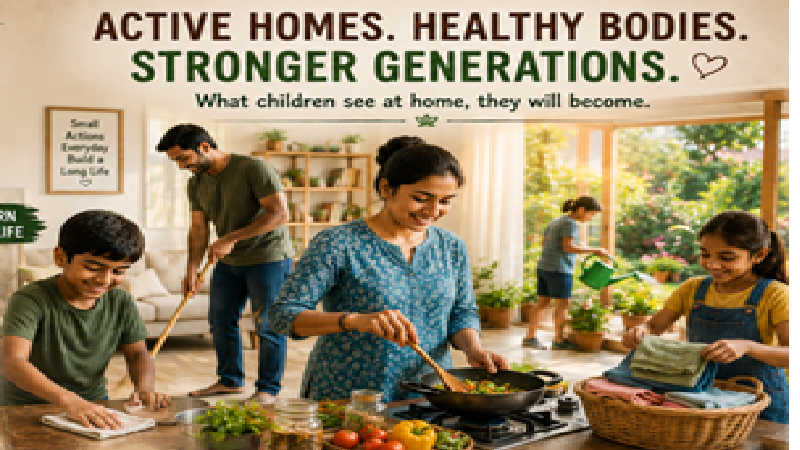
Do the children in your home see adults who wash things, clean spaces, cook, carry, sweep, garden, and organise?
Or do they mostly see adults sitting?
There is no blame in this question. There is only honest looking.
Convenience has made many things easier — and that is not wrong. But somewhere in the ease, the movement that once filled ordinary hours may have quietly disappeared.
What if movement is not exercise — but ordinary living?
For much of human history, people did not go to gyms. They did not follow wellness plans. They moved because life itself required it.
Water was carried. Floors were swept. Clothes were washed by hand. Food was grown, cut, ground, and cooked from scratch. Children were carried, put to sleep, brought outdoors. Elders were cared for. Spaces were maintained.
All of this was simply living. And living, in that sense, was inseparable from physical effort.
Today, machines have absorbed much of that effort. That is progress, and it has given us real gifts. But it has also quietly removed something — not from our lives as they are scheduled, but from our bodies as they are used.
What fills that space now?
There is an old idea worth reflecting on
It is sometimes said — gently, as observation rather than rule — that what cannot bend at five may not easily bend at fifty.
This is not a prediction. It is not a verdict on any child's future. But it does carry a question worth exploring:
Does the body learn its relationship with movement early?
Does a child who grows up in a home where physical participation is natural — where the hands are often doing something, where the body is often involved in the life of the house — carry a different relationship with effort into adulthood?
Perhaps not always. But perhaps often enough that it is worth thinking about.
If a child grows up without daily physical participation — without ever being part of the effort of a home — what relationship will they carry with effort later in life?
The household as a quiet teacher
Consider the small physical acts that once filled a family home:
- Cooking — standing, stirring, chopping, carrying
- Cleaning — bending, wiping, scrubbing, reaching
- Washing — lifting, wringing, hanging
- Gardening — digging, watering, walking outdoors
- Organising — carrying, sorting, climbing, arranging
- Caring — lifting children, supporting elders, moving toward others
None of these require willpower. None of them need to be scheduled. They simply happen — as part of the life of a home that is alive.
And when children are around while these things happen, they are not just witnessing tasks. They are absorbing a relationship between the body and living.
They are learning, without words, that life includes physical participation. That effort is not punishment. That the body is meant to be used — gently, daily, naturally.
Children may not remember the lectures
A child rarely remembers being told to be active. They almost never carry forward a conversation about health from childhood into their adult years.
But they may remember how their parents lived. The sounds and movements of a functioning home. The smell of food being made. The feeling of being given a task. The image of a parent carrying something with ease, or a grandparent tending a small space with calm attention.
These impressions are not taught. They are received — through the ordinary texture of a childhood lived in a particular kind of home.
What impressions about physical life are the children in your home receiving right now — not through what you say, but through how you live?
What may children quietly learn at home?
When a home remains physically alive — not perfectly, not dramatically, but in the small consistent ways of ordinary life — children may absorb something without being told:
- That movement is normal, not exceptional
- That health requires participation, not just luck
- That life includes effort — and effort does not break a person
- That small actions, repeated over years, add up to something real
- That the body is meant to move, and moving feels like living
These are not lessons delivered in classrooms. They are not found in books on health or fitness. They are felt — in the bones, in the habits, in the body's quiet memory of what was once ordinary.
When convenience replaces movement, what do we notice?
It is worth looking honestly, without alarm, at what has shifted.
Groceries arrive at the door. Machines wash the clothes and the dishes. Lifts replace stairs. Remote controls, voice commands, and delivery apps remove reasons to stand, walk, reach, or carry. Even within a home, the distances we move through a day have grown remarkably short.
None of this was chosen badly. Most of it arrived as relief. And yet, the body — which was built across thousands of generations for regular, varied, sustained movement — now goes for hours, sometimes entire days, without anything close to that.
And children are watching this too. They are learning that this is what modern life looks like.
Perhaps the question is not whether convenience should be refused. Perhaps it is simply whether something deliberate needs to step in where natural movement has stepped back.
The long horizon — what does a 120-year life require?
A life reaching 100 or 120 years may ask for things that cannot be borrowed suddenly in later decades.
It may ask for:
- A body that has been used consistently, not stored in stillness
- Joints and muscles that have known regular, gentle movement over many years
- Self-dependence — the ability to carry one's own weight, literally and otherwise
- An active daily life that does not require sudden reinvention at sixty or seventy
- A relationship with effort that was built early, not negotiated late
Perhaps long life is not built only in gyms, or by following structured programs. Perhaps it is shaped, more quietly, inside ordinary homes — in the years before anyone started thinking about longevity at all.
If parents cannot sustain healthy movement in daily life now, how will their children imagine a long active life as something possible? As something that looks like them?
Movement may simply be life itself
Here is a thought worth holding lightly:
Movement is not another item to add to a list. It is not a correction for something wrong. It is not a discipline to impose or a goal to achieve.
It may simply be what a life that is fully lived feels like — in the body, in the home, in the daily participation of being present and physically engaged with the world around us.
When a home moves, children grow up inside that movement. When a home is still, children grow up inside that stillness — and carry it forward, often without knowing.
If your children repeated your daily habits exactly — not the habits you intend, but the ones you actually live — for fifty years, what kind of body would they inherit?
And if a long life became possible — not as a burden, but as an opportunity — what everyday habits would make that life sustainable, capable, and genuinely free?
A quiet close
This is not a call to become someone different. It is not a suggestion that every home must become a place of constant exertion.
It is simply an invitation to notice — with honest curiosity — how much physical life still moves through your ordinary days. And whether the children watching those days are receiving, quietly, a relationship with movement that will serve them across the decades ahead.
Why not 100?
Why not 120?
Perhaps it begins… with moving together at home.