When you cook, do you only cook?
When you speak to your child, do you only speak?
When you are with your family, are you truly there?
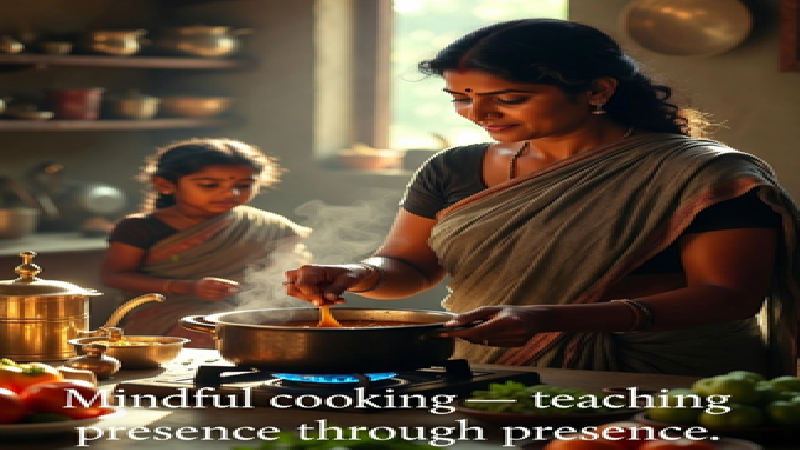
These are not trick questions. They are not meant to judge. They are simply quiet invitations to notice what may already be quietly unfolding in the background of everyday life.
Because something has changed in recent years. Not suddenly. Not dramatically. But slowly, steadily — attention itself has been quietly fragmented.
Is focus only needed for work?
When we hear the word "focus", we often think of offices, projects, deadlines, exams. Focus becomes something we associate with productivity, performance, achievement.
But is focus only needed when we are trying to succeed at something external?
Or is focus also needed:
- When cooking a meal for the family?
- When eating that meal together?
- When speaking to a child about their day?
- When listening — truly listening — to what someone is saying?
- When walking, bathing, cleaning, resting?
Perhaps focus is not only a professional skill. Perhaps it is also a life skill — one that shapes the quality of relationships, the depth of connection, and the calmness of the mind across decades.
If deep focus slowly disappears from ordinary life, what kind of presence remains?
When everything is always on, what happens to the mind?
Look around — quietly, without judgment.
A person is cooking. But the phone is on the counter, screen glowing. A notification arrives. A message. A video. The hand reaches, the scroll begins. The stirring continues — but is the mind still in the kitchen?
A parent is speaking to a child. But the TV is on in the background. The podcast is playing. The group chat is buzzing. The words are being spoken — but are they truly landing?
A family is eating together. But one person is checking emails. Another is watching a reel. A third is texting. The food is being consumed — but is the moment being shared?
This is not an attack on technology. This is not nostalgia for a world without phones, music, or modern conveniences. This is simply a soft pause to ask:
When everything is always on, when attention is constantly pulled in ten directions at once, what happens to the mind over time?
The quiet cost of constant context switching
Context switching is a term from computing. It means the brain is rapidly jumping between different tasks, different streams of input, different states of attention.
It feels productive. It feels modern. It feels normal.
But what may be happening underneath?
- The mind may be training itself to always be partially present, never fully present.
- Attention may be becoming shallower, unable to rest on one thing for long.
- Listening may be weakening — hearing words but not absorbing them.
- Emotional connection may be thinning — being physically near someone but mentally elsewhere.
- Calmness may be eroding — the inner noise rising even when the outer world is quiet.
None of this happens in a day. It accumulates slowly, over years, across thousands of small moments when attention was divided instead of whole.
If you spend twenty years doing everything with divided attention, what kind of mind will you carry into the second half of life?
The example of cooking — fully
Let us take one simple act: cooking for your children.
A parent stands in the kitchen. Rice is on the stove. Vegetables are being chopped. Water is boiling. The child is somewhere nearby — perhaps at the table, perhaps doing homework, perhaps just watching.
Now imagine two versions of this moment.
Version One: The phone is on the counter. A notification arrives. The parent glances. A video autoplays. The mind drifts to something someone posted. The chopping continues, but the attention has moved elsewhere. The cooking is happening, but the presence has left.
Version Two: The phone is in another room. The music is off. The TV is silent. The parent is only cooking. Feeling the knife against the board. Noticing the smell of the spices. Adjusting the heat. Perhaps humming softly. Perhaps speaking to the child about something small. The cooking is happening, and the presence is fully there.
Both versions produce food. But do they produce the same experience?
In the first version, the child may observe a parent who is physically present but mentally elsewhere. In the second, the child may observe something rarer — a parent who is doing one thing, fully.
What children quietly learn by watching
Children do not need lectures on focus. They need examples.
They do not learn from what we tell them. They learn from what we show them — day after day, in the small, ordinary moments no one is paying attention to.
If a child grows up in a home where every act is fragmented — where cooking happens with one hand and scrolling with the other, where meals are eaten with eyes on screens, where conversations are interrupted by notifications — what is that child learning about attention?
They may be learning that doing one thing fully is old-fashioned. That multitasking is normal. That constant stimulation is necessary. That silence is uncomfortable. That presence is optional.
But if a child grows up in a home where some moments are protected — where cooking is just cooking, where eating is just eating, where speaking is just speaking — they may be learning something else.
They may be learning:
- That presence is powerful
- That listening is a form of respect
- That patience is possible
- That deep work exists
- That emotional connection requires undivided attention
- That calmness is built, not inherited
None of this is announced. It simply enters them, silently, the way habits always do.
If we lose deep attention, do we also lose deep connection?
Here is a gentle question worth sitting with.
If a parent spends fifteen years being physically present but mentally distracted — always half-listening, always half-there, always one notification away from disappearing into the phone — what kind of relationship is quietly being built?
The child may grow. The years may pass. But one day, when that child is a teenager or a young adult facing something difficult, will they turn to that parent? Will they feel heard? Will they trust that their words will land?
Or will they have learned, over a thousand small moments, that true attention is not really available?
Perhaps connection is not only about love. Perhaps it is also about presence. And perhaps presence cannot exist when attention is constantly somewhere else.
If your children do not experience deep connection at home, who will they listen to when they become adults?
A focused mind may handle crisis better
Life does not unfold smoothly for anyone. Crises arrive. Health challenges. Financial difficulties. Relationship breakdowns. Unexpected losses.
When such moments come, what helps a person stay steady?
Is it only willpower? Is it only support from others? Or is it also something quieter — a mind that has been trained, over years, to focus on one thing at a time?
A mind that can think clearly when things are chaotic.
A mind that does not fragment under pressure.
A mind that can be present with difficulty without collapsing into panic.
Perhaps mental resilience is not only about personality. Perhaps it is also the long-term result of how attention has been used — or scattered — over decades.
What may children quietly learn from focused parents?
If a child grows up observing parents who regularly practice deep focus — even in small, ordinary acts — they may quietly absorb:
- Presence — the ability to be fully here, now, with what is in front of them
- Listening — not just hearing, but truly absorbing what someone is saying
- Patience — the willingness to let something take the time it takes
- Deep work — the capacity to stay with one thing for an extended period
- Emotional connection — the trust that comes when someone is genuinely available
- Respect for attention — the understanding that where attention goes, life follows
These are not lessons taught in a single conversation. They are absorbed slowly, across years, through the quiet example of a life lived with some measure of focus.
The connection between focused living and long life
A life that reaches 100 or 120 years may require many things — good food, regular movement, sufficient rest, emotional stability. But perhaps it also requires something less often discussed:
A calm mind.
A mind that is not constantly fragmented by distraction. A mind that can be with itself without needing endless stimulation. A mind that has practiced, over decades, the simple act of doing one thing at a time.
Perhaps mental fragmentation over fifty years wears the body down in ways we do not yet fully understand. Perhaps constant overstimulation quietly exhausts the nervous system. Perhaps the inability to be present erodes emotional health — and with it, the relationships that help a person live long.
Perhaps long life is not only about what we eat. Perhaps it is also about how we pay attention.
If distraction becomes normal for decades, what kind of adult will a child become? If focus becomes normal at home, what strength may they carry into life?
This is not about perfection
This reflection is not suggesting that every moment must be perfectly focused. That every meal must be silent. That every act must be done in isolation.
Life is messy. Distractions will come. Phones will ring. Children will interrupt. Plans will change.
But perhaps, amid all that, some moments can be protected. Some acts can be done fully. Some conversations can be had without a screen glowing nearby.
Not because distraction is evil. But because presence is valuable.
Not because multitasking is wrong. But because deep connection requires deep attention.
Not because the past was perfect. But because the future may depend on whether we remember how to be fully here.
A small practice worth considering
What if, just as an experiment, one small act each day was done with full attention?
Cooking one meal — without the phone, without the TV, without the podcast.
Eating one meal — with the family, without screens, without rushing.
Speaking with a child for ten minutes — without checking messages, without interruptions, without mental drift.
Walking for fifteen minutes — without music, without scrolling, just noticing the world.
Not forever. Not perfectly. Just once a day.
And then noticing — quietly, without judgment — what changes. In the mind. In the connection. In the calm that may or may not begin to return.
Perhaps attention itself is life energy
Here is a thought worth sitting with.
Perhaps where attention goes, life follows. Perhaps what receives our focus grows stronger. Perhaps what is ignored slowly fades.
If we give scattered attention to everything — to work, to children, to health, to relationships — perhaps everything receives just enough to survive, but nothing receives enough to truly thrive.
But if we can protect moments of deep attention — for the people who matter, for the acts that nourish, for the silence that restores — perhaps something different becomes possible.
Perhaps we build connection that lasts. Perhaps we teach presence by example. Perhaps we create a home where calmness is not a distant memory but a lived experience.
And perhaps that calmness — cultivated over years, passed quietly to children, carried into the second half of life — becomes one of the invisible foundations of a life that reaches 100, 120 years.
When a parent does one thing fully, a child may learn how to live fully.
A few reflective questions to sit with
Not to answer immediately. Not to create guilt. Just to notice.
When you last cooked for your children, were you only cooking — or was your attention divided?
When you last ate a meal with your family, were you fully there — or partially somewhere else?
When your child spoke to you today, did you only listen — or were you also thinking about the next thing?
If your children copy your attention habits for the next fifty years, what kind of mind will they inherit?
If you lose deep connection with your children today, how will they hear you tomorrow?
And if attention is life energy — where is yours going?
Perhaps it begins with doing one thing fully
Living 100 years. Living 120 years. These are not fantasies. They are possibilities — real, tangible, reachable.
But they may require more than diet and exercise. They may also require a mind that has not been exhausted by decades of fragmentation. A nervous system that has learned to rest. Relationships that have been built on true presence, not physical proximity alone.
Perhaps the journey toward long life does not begin with a dramatic change. Perhaps it begins with a simple decision — repeated daily, quietly, without fanfare:
To do one thing fully.
To cook without distraction. To speak without scrolling. To listen without planning the reply. To be where you are, when you are there.
And perhaps — just perhaps — that small practice, carried across years, becomes the quiet foundation of everything else.
If your children copy your attention habits for fifty years,
what kind of mind will they inherit?
If you lose deep connection with your children today,
how will they hear you tomorrow?
Why not 100?
Why not 120?
Perhaps it begins…
with doing one thing fully.