How are you spending your time today?
Do you know where your attention went this week?
If someone asked you to account for the last seven days — hour by hour — would the picture feel familiar, or would it surprise you?
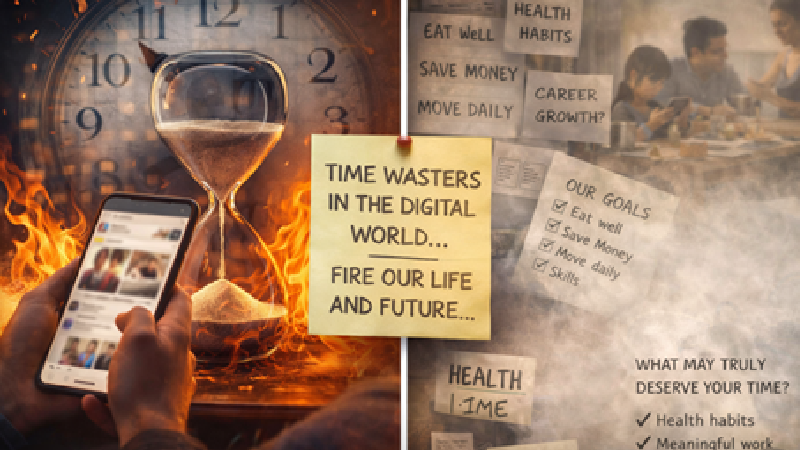
Time does not announce itself. It does not remind you how much has passed. It simply moves — and whatever fills it becomes what the day was made of.
The question is not whether you are busy. Most people are. The question is — what is your time actually being filled with?
Do people truly value their time?
Not in theory. In practice.
Almost everyone will say time is precious. Almost everyone will agree that a day lost cannot be recovered. But how many people sit down at the end of a week and honestly ask — where did it go?
When time is not consciously held, it does not stay empty. It fills itself. And in the current age, what fills it most effortlessly is the screen.
Not because people choose it deliberately. But because it requires no effort. No planning. No decision. The phone is already in the hand. The feed is already refreshing. The next video is already playing.
When time is not given a direction, does it quietly find the nearest screen?
The quiet drift
No one sets out to spend three hours scrolling. No one plans to watch an entire afternoon of short videos. No one decides, at the start of the day, that today will be spent following the lives of people they have never met.
And yet, it happens. Day after day.
A quick check becomes twenty minutes. A single video becomes a chain of ten. A match update becomes an evening of commentary. A social media post becomes an hour of reading reactions from strangers.
How many hours go into scrolling through feeds that reset every few seconds? How many evenings are spent watching content that leaves no memory the next morning? How much mental space is occupied by celebrity news, match scores, film reviews, and opinions from people who do not know you exist?
None of this arrives with a warning label. None of it feels heavy in the moment. That is precisely why the drift goes unnoticed.
This is not about right or wrong
Entertainment has always existed. Leisure has always mattered. No culture has ever survived without celebration, story, and play.
The question here is not whether digital platforms are good or bad. They are tools. The question is about proportion — and awareness.
When someone spends an hour watching a film they chose intentionally, that is engagement. When someone spends three hours watching content they did not choose — carried along by autoplay and algorithmic suggestion — that may be something else.
When someone follows cricket because they love the sport, that is a connection. When someone follows every match, every auction, every controversy, every post-match debate — day after day, season after season — it may be worth asking: what is this pattern building over ten years?
The long-term question is not what you consumed today. It is what shape your days are quietly taking — week after week, year after year.
What happens to the body and mind?
Does constant consumption improve physical health?
Does it sharpen mental clarity?
Does it build emotional stability?
These are not rhetorical questions. They are practical ones. Because the body does not distinguish between time spent well and time spent passively. It simply records the effect.
Sitting for long hours with a screen affects posture, circulation, and sleep quality. Rapid-fire content affects attention span, patience, and the ability to stay with slow, meaningful tasks. Constant digital stimulation leaves the mind restless even when the screen is off.
And none of this shows up in a single day. It accumulates — quietly, steadily, over years — until the body or the mind signals that something has shifted.
What are children absorbing?
Children do not evaluate adult behaviour. They absorb it as the standard.
When a child sees a parent reach for the phone first thing in the morning, the child learns that this is how a day begins. When a child sees an evening spent switching between apps and videos, the child learns that this is how rest looks. When a child sees meals eaten beside a screen instead of beside a conversation, the child learns that this is how people connect.
No one teaches these things. No one intends them. But the household environment becomes the child's first definition of normal.
And the child who grows up inside a digitally saturated household may carry that definition forward — into their own habits, their own health, their own families.
If this pattern continues for one generation, the effects may be subtle. If it continues for two or three, the effects may become structural — shaping how entire families relate to time, health, and presence.
What do children learn when the most consistent activity they observe at home is consumption — of content, of feeds, of other people's lives?
What may truly deserve your time?
Not as a prescription. Just as a mirror.
- Health habits — the walk that strengthens the body slowly, the food that builds rather than entertains
- Meaningful work — the kind that leaves you more capable at the end of the day than at the beginning
- Family presence — not sitting in the same room, but actually being in the same moment
- Skill building — the slow accumulation of ability that compounds over decades
- Inner clarity — the quiet time that lets the mind settle, observe, and understand itself
These are not dramatic activities. They do not trend. They do not notify. But they are the things that, over a lifetime, determine the quality of the body, the sharpness of the mind, and the depth of the relationships that surround a person.
The connection to a long life
A life that reaches 100 or 120 years does not arrive by accident. It is built — quietly, daily, through how time is used.
It may require conscious use of time — not rigid control, but gentle awareness. It may require reduced mental clutter — not emptiness, but space for what matters. It may require consistent habits — not perfection, but repetition of things that serve the body and mind. It may require active engagement with life — not passive reception of content designed by someone else.
If time is unconsciously consumed — year after year, decade after decade — what happens to long-term health? Physically? Mentally? What kind of foundation is being laid for the later decades of life?
Time is not separate from life. Time is life. Where time goes, life follows. Not in theory — in the actual shape of the days, the years, the body, the mind.
A life designed to last 100–120 years may begin with a single shift: noticing how the hours are spent — and gently reclaiming the ones that were drifting away unnoticed.
A few questions to sit with
If your current time usage continues for thirty years, what kind of life will it build?
If your children repeat your daily patterns — the scrolling, the watching, the consumption — what will their health and habits look like at forty?
If someone recorded how your last month was spent, hour by hour — would the picture reflect the life you actually want?
These are not questions that need answers tonight. They are questions that may deserve a quiet hour — without a screen — to hold.
Why not 100?
Why not 120?
Perhaps it begins with how we value our time.