Have you ever wondered — who is holding your home together while the world races ahead?
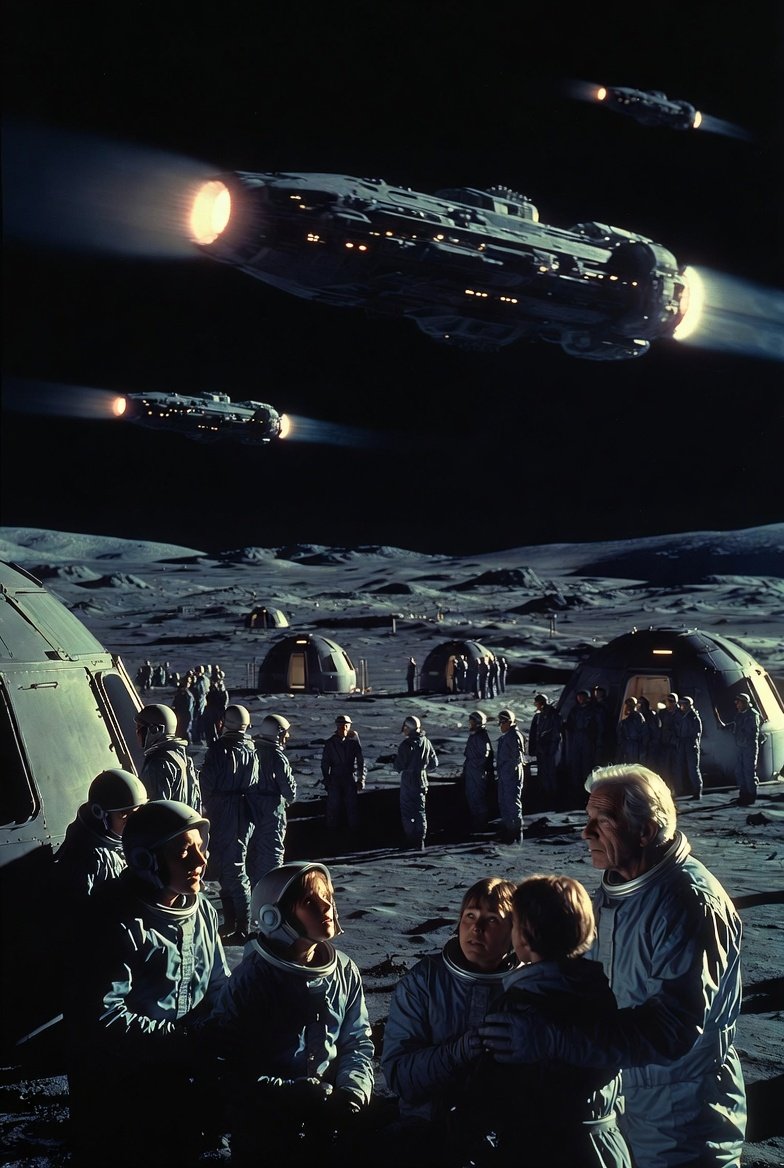
We live in a time when people are thinking about Mars. About building cities on the Moon. About expanding human consciousness beyond what any previous generation imagined possible.
Thinkers like Elon Musk speak of multi-planetary futures — not as fantasy, but as long-term vision. The kind of thinking that stretches across decades and generations, not just quarterly results.
And something about that vision stirs us. It reminds us that humans are capable of dreaming very, very far ahead.
But here is a quiet question worth sitting with:
If we are building for centuries ahead — what is happening inside our homes right now?
A species that dreams of reaching the stars still needs families that can stay calm, healthy, and wise for 120 years on Earth. One doesn't replace the other. One makes the other possible.
Are we thinking far ahead — but forgetting what's right here?
We admire long-horizon thinking. We celebrate innovation. We fund research into artificial intelligence, space travel, brain interfaces.
But when was the last time we paused and asked — who is the steadiest person in my home? Who holds the emotional ground when things shake?
For most of human history, the answer was an elder. A grandmother. A grandfather. Someone who had lived through enough seasons to know that not every storm requires panic.
Not a CEO. Not a technologist. Just someone who had been here long enough to say, without words: This too shall pass. I have seen it before.
That presence — quiet, unhurried, unshakable — is what gave families the emotional architecture to face anything.
And today? In many homes, that presence is gone. Not because elders chose to leave — but because lifestyle habits slowly took them away, decades too early.
What happens to a family without its anchor?
Think about it honestly.
When the eldest members of a family are gone by sixty or seventy — not from old age, but from habits that weakened the body long before its time — what is left behind?
Young adults facing every disruption alone. Job losses. Financial shocks. Technology shifts that change entire industries overnight. AI replacing roles that once felt permanent.
And no one beside them who has already lived through upheaval and come out steady.
Children growing up seeing only reactive adults. Stressed adults. Scrolling adults. But rarely an elder who simply sits, listens, and responds from a place of deep calm.
A family without its elder is like a tree without deep roots. It may stand in fair weather. But when the winds come — and they always come — it has nothing to hold it in place.
Do your children know what patience looks like — lived, not lectured?
Here is something worth sitting with.
Children don't learn calm from a book. They don't learn patience from a lesson. They learn it by watching someone in their home who is calm. Who is patient. Not because life was easy for that person — but because they have lived long enough to carry difficulty without breaking.
An elder who has seen eighty, ninety, a hundred years doesn't need to understand AI or space exploration to matter. They carry something no app can deliver: the lived proof that a human nervous system can remain steady across decades of change.
That proof becomes something the child absorbs. Not through instruction. Through atmosphere.
And years later, when that child faces their own wave of uncertainty — a career collapse, a health scare, a world that feels like it's shifting too fast — they reach inward and find something there. A memory of steadiness. A pattern they inherited without knowing it.
That is what an elder gives a family. Not advice. Not control. Presence.
The fear no one talks about at the dinner table
Let's be honest about what runs quietly through many homes today.
A fear of survival. A fear that the world is speeding up and we are falling behind. A fear about what our children will face — pressures we can't even name yet.
AI is reshaping work. Economies feel unstable. The news delivers tension faster than any generation before us has experienced. And underneath it all, a low hum of worry: Will my children be okay? Will I be okay?
This fear is not wrong. It is human. But when it sits in the body unmanaged — day after day, year after year — it quietly does its damage. Sleep becomes shallow. Digestion weakens. The heart works harder than it should. The nervous system never fully rests.
And children feel that tension. They absorb it at the dinner table. They sense it in the late-night silences. They inherit not just our words, but our atmosphere.
Children don't inherit only what we teach. They inherit how we breathe when things get hard. They inherit whether the home they grew up in was a place of quiet strength — or constant alarm.
What does living 120 years actually require?
We speak often at YNot100 about 120-year living. Not as a fantasy. As a design — written into the human body, waiting to be honored through how we live each day.
But living that long is not only about food, movement, or medicine. It asks something deeper of us:
- A nervous system trained to stay calm — not through avoidance, but through steady, daily practice
- Emotional resilience that comes from feeling difficulty fully, without being consumed by it
- Habits shaped by awareness — what we eat, how we sleep, how we respond when the world feels uncertain
- The quiet understanding that our long life is not for us alone — it is for the children and grandchildren who will one day need our presence
Every year you add to your healthy life is a year your grandchild has a living teacher. Every decade of calm you cultivate becomes something your family can draw upon when the ground shifts beneath them.
This is not vanity. This is service. The most invisible, most necessary kind.
Can we dream of the stars — and still tend to the home?
This is not a question of choosing one or the other. It never was.
The thinkers who build rockets and the grandmothers who hold families together are not doing different work. They are doing the same work — across different scales. One expands what humanity can reach. The other steadies what humanity already has.
We need the dreamers who look at the Moon and see a future worth building. And we need the elders who look at a worried grandchild and say, without drama: You'll be fine. I'm here.
A civilization that develops only its ambition — without deepening its emotional roots — will stumble. We can build spacecraft that cross the solar system. But if the families inside those communities are anxious, fractured, and without elders to steady them — what exactly have we carried to the stars?
A gentle reminder before you close this page
You don't need to build a rocket to contribute to human progress.
You can begin by deciding to live longer. To live calmer. To build habits that protect your body and your nervous system — not for your own sake, but for those who will one day need your steadiness.
You can begin by asking yourself, quietly: Am I building the kind of health that lets me be here — truly here — for my family at eighty? At ninety? At a hundred?
To reach the stars, we must first become stable on Earth. Inside our homes. Inside our bodies. Inside the quiet space where an elder's presence teaches a child that the world — for all its uncertainty — can still be met with grace.
Why not 100 years? Why not 120? Not as a personal milestone — but as the most profound gift you can offer your children, and theirs.