With all this progress around us, what has happened to the human body and mind?
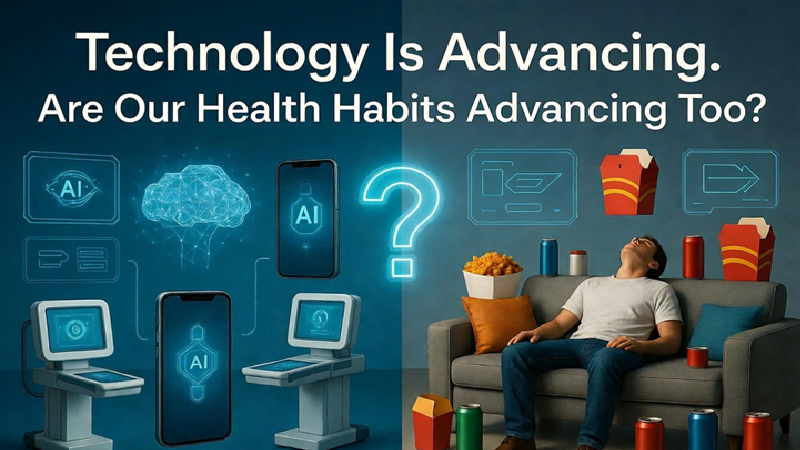
Technology is advancing every day.
Life has become easier in many ways. Communication happens in seconds. Information arrives before questions are fully formed. Tasks that once demanded hours now complete with a few taps. Medical support is more accessible. Devices automate much of what used to require manual effort. Convenience has reshaped almost everything.
This is not about rejecting any of that. Progress has real value. Technology has genuinely improved many aspects of modern life.
But here is the question worth sitting with for a moment:
Are our health habits advancing at the same pace?
What has modern life improved?
The changes are visible everywhere:
- Faster communication across continents
- Easier travel and transportation
- Online services for banking, shopping, learning
- Instant access to information and knowledge
- Better medical tools and treatment options
- Automation at home and at work
- Greater comfort in daily routines
All of this is real. All of it has made certain parts of life simpler.
But with all this progress, what has happened to the human body?
What has happened to the mind?
When convenience replaces movement
When machines do more of the work, what happens to natural movement?
When cars replace walking, elevators replace stairs, devices replace manual tasks — where does the body's daily activity quietly disappear to?
Convenience is not wrong. But perhaps balance has become harder to see.
A generation ago, ordinary life involved more physical movement simply by necessity. Cooking, cleaning, walking to places, carrying things, standing for hours — these were not exercise routines. They were just life.
Today, life can be lived almost entirely while seated. Work happens on screens. Entertainment happens on screens. Shopping, learning, socializing — much of it no longer requires the body to move.
Is this progress? In one sense, yes. In another sense — what is it quietly removing?
Are health habits keeping pace with technological progress?
Ask gently:
Have food habits improved with all this progress?
Has physical activity increased?
Has sleep become deeper and more restful?
Has the mind become calmer?
Have families become more emotionally connected?
If the answers are uncertain, then what kind of progress are we really living through?
Perhaps technology has advanced faster than wisdom about how to use it.
Technology as a tool — not a substitute for living
Technology can support many things:
- Learning and education
- Healthcare and diagnosis
- Work and productivity
- Communication and connection
- Safety and security
- Planning and organization
But can it replace:
- Movement?
- Discipline?
- Nutritious food?
- Emotional presence?
- Family responsibility?
- Daily self-care?
These are not questions with loud answers. They are meant to be felt quietly.
Health still begins at home
Look at the ordinary rhythms of family life today:
Are meals cooked at home with attention and simplicity?
Do family members eat together without screens nearby?
Is there daily movement — not as formal exercise, but as natural activity?
Is the home cleaned and maintained by those who live in it?
Does sleep happen at regular times, in a quiet environment?
Are screens used carefully, or do they fill every gap in the day?
How do adults speak to each other when things are difficult?
Is stress responded to calmly, or does it escalate automatically?
These habits do not require advanced technology. They are simple. Human. Foundational.
Can any device replace them?
The maturity to think long-term
Maturity is often measured by visible success — earning capacity, career growth, purchasing power, access to the latest technology.
But perhaps real maturity also includes asking:
"What will this lifestyle do to my family after thirty or fifty years?"
A life designed for short-term convenience may quietly build patterns that become difficult to change later. A child who grows up in a home where convenience is normal may not develop the resilience needed for a long, healthy life.
Is maturity only about what we achieve today — or does it also involve what we pass forward?
Children learn the family's health culture
Children may not learn health from advice alone.
They learn from:
- What is cooked at home
- How adults eat
- Whether movement is part of daily life
- How the family rests and recovers
- How devices are used
- How stress is handled
- The way parents respond to discomfort
If children repeat the family's current habits for fifty or sixty years, where might those habits quietly lead them?
Children do not inherit advice. They inherit patterns.
What happens across generations?
If one generation becomes less active, what does the next generation consider normal?
If one generation depends entirely on convenience, what level of self-dependence will the next inherit?
If one generation restores healthy habits consciously, could that also travel forward into the future?
Patterns do not stop with one person. They shape families. They shape assumptions about what life should look like. They create the starting point for those who come after.
What may still build a long, healthy life?
Some things may not change, even as technology advances:
- Simple and mindful food habits
- Daily physical movement
- Consistent, restorative sleep
- Emotional calm and inner steadiness
- Strong family relationships
- Responsible use of technology
- Long-term thinking about health
None of these require the latest tools. None require expensive memberships. They are ordinary. Human. Repeatable across decades.
Perhaps they are still the foundation of a life that reaches 100 or 120 years.
Convenience and capability
When more work is done by machines, what happens to natural movement?
When everything arrives at the door, what happens to self-dependence?
When screens fill every free moment, what happens to sleep, attention, and family connection?
Convenience is not the problem. But perhaps the question is — are we still capable of living without it when needed?
A body that depends entirely on automation may lose strength quietly. A mind that depends entirely on entertainment may lose calm. A family that depends entirely on convenience may lose connection.
Perhaps balance is not about rejecting progress. Perhaps it is about staying capable alongside it.
A 100–120 year life in a modern world
A life reaching 100 or 120 years may require more than technological advancement.
It may require:
- A body that continues to move naturally
- A mind that remains clear and steady
- Food habits that support long-term health
- Emotional balance across decades
- Practical self-dependence
- Strong family connection
- Habits repeated consistently across decades
Perhaps technology can help people live longer. Perhaps medical science will continue making progress. But perhaps the way those years are lived still depends on something quieter.
On habits formed at home. On movements done daily. On meals eaten together. On sleep protected carefully. On stress managed calmly.
The future of longevity may not be built only in laboratories or hospitals. It may also be built in kitchens, in walking routines, in family conversations, and in the small choices made every day.
Where are we standing today?
Technology will continue advancing. That is certain.
The question is not whether to stop progress. The question is whether we are growing wisely alongside it.
Are we using modern tools to support a healthier life — or are we quietly allowing convenience to replace capability?
Are children learning to use technology — or are they learning to depend on it entirely?
Are families becoming more connected through technology — or more distracted by it?
These are not questions with immediate answers. They are meant to create a pause. A moment of reflection.
A gentle close
If technology continues advancing for the next fifty years, will your family's health advance with it?
If your children inherit both modern tools and your current habits, which one will shape their future more?
What is your home quietly teaching about long life today?
Perhaps the answer is not in rejecting progress. Perhaps it is in staying grounded while moving forward.
Perhaps it is in using technology wisely — without losing the simple, human habits that may still be the foundation of a life lived long and well.
Why not 100?
Why not 120?
Technology may open the door. But perhaps our daily habits decide how far we walk.