The same event, two different minds
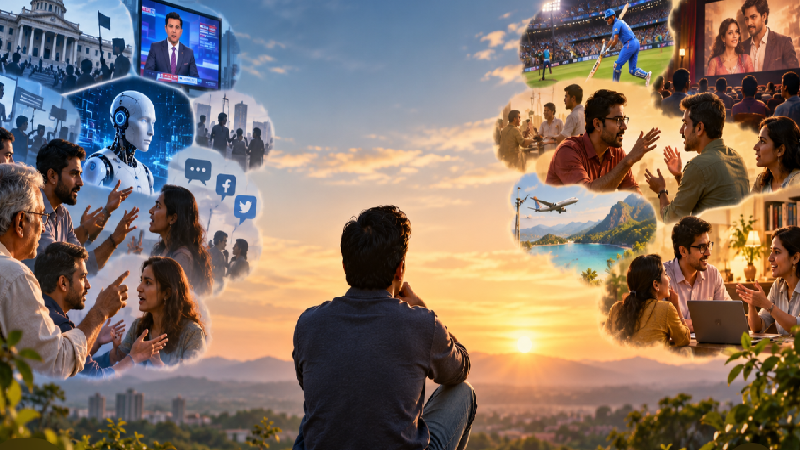
Two people watch the same film.
One loves it. One hates it.
Two people see the same technology.
One sees possibility. One sees danger.
Two people watch the same political event.
One celebrates. One becomes angry.
The event is the same. The minds receiving it are different.
Where are you in all of this?
When you choose a side, what happens inside you?
Why do we take sides?
Why do humans naturally form preferences?
A film actor? A political idea? A cricket team? A technology? A company? A social issue? A way of living?
Perhaps preferences themselves are ordinary parts of human life.
The deeper question is: what happens after the preference forms?
Does “I prefer this” quietly become “This is me”?
And then can “You disagree with this” begin to feel like “You disagree with me”?
When does an opinion become identity?
You like a political leader. Are you that leader?
You support a cricket team. Are you that team?
You admire an actor. Are you that actor?
You believe strongly in a technology. Are you that technology?
You support an idea. Are you only that idea?
When something we support is criticised, why can it sometimes feel as though we ourselves were criticised?
Can two people see the same thing differently?
A new technology arrives.
One person asks, “What can this enable?” Another asks, “What could this disrupt?”
Could both questions be worth hearing?
A film releases. One person sees art. Another sees something they dislike.
Does either reaction need to become personal?
A workplace decision is announced. One employee sees opportunity. Another sees difficulty.
Could circumstances explain part of the difference?
Before deciding what someone else's view says about them, do we ever wonder what they are seeing that we are not?
Seeing another side does not require abandoning your own
If you understand why another person thinks differently, have you surrendered your own view?
If you listen, have you agreed?
If you acknowledge complexity, have you become weak?
Could someone say “I still disagree” and also say “I understand why you see it differently”?
Could those two sentences live together?
What happens when “my side” wins?
Your team wins. Your candidate wins. Your favourite film succeeds. Your preferred technology dominates. Your opinion is proven correct.
What happens inside? Joy? Satisfaction? Relief? Pride?
And how long does it remain?
Then — what happens when the opposite occurs?
If our inner state rises and falls continuously with things outside our control, who is controlling whom?
How much of your inner state belongs to the outside world?
A headline changes your morning. A comment changes your afternoon. A sports result changes your evening. An online argument follows you into dinner. A political disagreement follows you into bed. A workplace disagreement follows you home.
When the event has ended outside, why is it still happening inside? And how long do we want to host it?
Can you care without being consumed?
Can politics matter without politics becoming the whole mind?
Can technology matter without every debate becoming personal?
Can sport matter deeply and still remain sport?
Can cinema move us without celebrity conflict occupying our family conversations?
Can social issues matter while we preserve the ability to listen?
Can we care strongly without being consumed completely?
Perhaps this is closer to “being centered.”
What about when something is genuinely wrong?
What if you witness something you deeply believe is unfair?
What if silence itself feels wrong?
Could being centered still allow action? Could calmness coexist with courage?
Could someone oppose something strongly without allowing hatred to occupy every part of them?
Could someone defend a principle while still remembering the humanity of the person on the other side?
This is not always easy. Simply ask whether conviction requires inner chaos.
What happens inside the family?
Politics can divide families. Money can divide families. Cinema preferences can create arguments. Lifestyle choices can create disagreements. Technology use can divide generations. Parenting approaches can differ.
Two people who love each other may disagree. What happens next?
Does disagreement become distance?
Does winning the argument become more important than understanding the person?
Can a family hold different views and still remain a family?
What are children watching when adults disagree?
What are children learning from how we disagree?
Children may hear adults say, “Respect everyone.”
But what do they see when someone holds an opposing view?
Curiosity? Mockery? Anger? Listening? Dismissal? Questions? Silence? Conversation?
What might they quietly learn about disagreement?
And decades later, when they encounter people who think differently, what relationship with difference might they carry forward?
What did the generation before you disagree about?
What did your parents disagree about? What divided your grandparents' generation?
Which arguments that once seemed enormous barely matter today?
Which ones still matter? Which beliefs changed with time? Which remained?
Could some things consuming us today also look very different thirty years from now?
What will still matter at 90?
Imagine yourself at 90. Perhaps 100. Looking backward.
How many elections, films, matches, technology debates, online arguments, news cycles and public controversies will have passed through your lifetime?
Some may have mattered greatly. Some may have disappeared almost completely.
What might remain? Relationships? Memories? The people you loved? The way you treated people? The mind you carried through those decades? The children who watched how you responded to disagreement?
If you want to carry this mind for 120 years
If you aspire toward a healthy, capable and meaningful life at 70, 90, 100, perhaps 120, what kind of mind would you hope to carry there?
A mind capable of changing its view? A mind capable of listening?
A mind capable of saying “I was wrong”? A mind capable of saying “I still disagree”?
A mind capable of seeing complexity? A mind that can remain curious about a world that may become completely different?
Could being centered matter in a very long life?
The world at 100 may not look like the world today
Imagine someone currently 40 reaching 100.
How different might technology, work, family structures, entertainment, communication, social norms, politics and daily life become?
We do not know.
If the world keeps changing, could the ability to see more than one perspective help us remain connected to younger generations?
What happens if every new generation is immediately judged because it sees the world differently?
Could curiosity help generations continue talking?
Being centered is not “not caring”
Being centered does not necessarily mean having no opinion, having no values, avoiding difficult conversations, accepting everything, or remaining silent.
Could it mean knowing where you end and the argument begins?
Could it mean noticing when an issue deserves action, and when it is simply consuming you?
Could it mean holding a principle without allowing hatred to become part of the principle?
Could it mean remaining capable of seeing another human being behind another opinion?
Where is your center?
- What opinion has occupied you recently?
- Why does it matter to you?
- What might the other person be seeing?
- Can you understand their view without accepting it?
- If they never agree with you, what happens inside you?
- Will this matter to you ten years from now?
- Is the disagreement affecting someone you love?
- What are your children observing?
- Does this deserve the amount of inner space it currently occupies?
- If you carried this pattern for another fifty years, what would you notice?
What might healthy longevity have to do with this?
If healthy longevity includes not only the body but also the quality of the years we live, could inner steadiness deserve reflection?
If a person reaches 100 but spends decades being pulled emotionally by every external conflict, would that resemble the long life they imagined?
If someone remains curious, connected and capable of engaging with younger generations, could that make those later years feel different?
What could travel to the next generation?
Your child may one day become a parent. Their child may encounter a world you cannot imagine. Different technology. Different politics. Different entertainment. Different social expectations. Different arguments.
What could you possibly give them that remains useful?
Your political opinions? Perhaps some.
Your knowledge of today's technology? Perhaps.
But could something else travel farther? The ability to listen. To question. To change. To disagree. To remain curious. To see complexity. To return to one's own center.
Could these be a meaningful inheritance?
Can you see both sides without losing your center?
Perhaps the question is not “Which side should I take?”
Sometimes a side genuinely matters.
Perhaps another question can exist beside it:
While I take this side, am I losing myself?
And: can I see another perspective without surrendering my own?
And perhaps: can I care deeply without allowing every conflict in the world to live permanently inside me?
Tomorrow there will be another headline
Another opinion. Another technology. Another film. Another match. Another political argument. Another person who sees something differently from you.
Perhaps you will agree. Perhaps you will disagree. Perhaps you will care deeply.
But somewhere beneath all of those changing things, where are you?
Ten years from now, many of today's arguments may have changed.
Fifty years from now, the world itself may look unfamiliar.
If you hope to remain part of it — still learning, still listening, still connected to children and grandchildren, still capable of holding your own view while hearing another — what kind of inner center would you want to carry?
If children learn something from watching how we disagree, what might we be passing forward?
Why not 100? Why not 120?
Perhaps a long life means living through many versions of the world.
And perhaps one question worth carrying through all of them is:
Can the world keep changing around me without every change taking away my center?