Where did your attention go today?
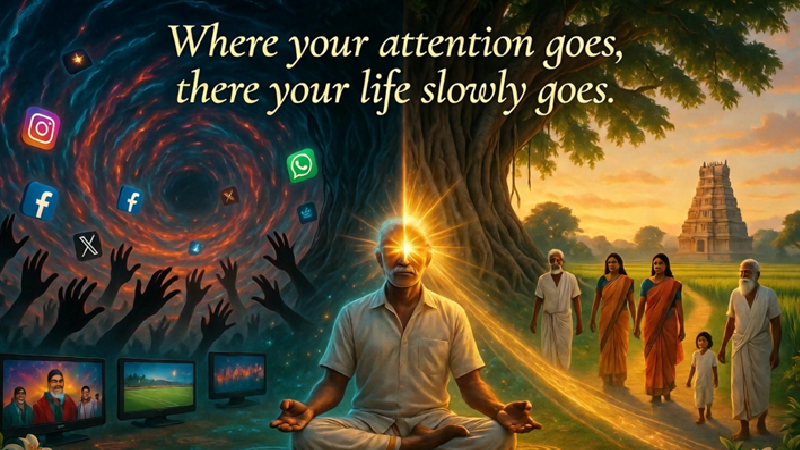
Did it go to your life — or to someone else's noise?
Who received your best attention this week?
Was it your child? Your health? Your inner calm?
Or was it the latest political debate, the cricket match, the celebrity scandal, the WhatsApp forwards, the Instagram reels, the X timeline, the Facebook arguments?
If time is life, is attention the direction of life?
We measure life in years. But life is actually lived in moments. And moments are shaped by where attention rests.
A year can pass with thousands of hours given to screens, opinions, news cycles, and entertainment. Another year can pass with those same hours given to health, children, skills, and calm.
The number of years is the same.
But what those years build — is not.
The modern pull of attention
This is not a reflection against politics, sports, cinema, or social media. These have their place. They always have.
The question is simpler:
How much of your inner space do they occupy — daily?
Politics can pull attention for months before an election. Discussions. Predictions. Arguments. Emotional reactions to outcomes that may not directly touch your life.
Sports seasons arrive — cricket tournaments, football leagues, endless matches. Conversations revolve around scores, players, teams. Evenings are organized around broadcast schedules.
Cinema and entertainment — new releases, celebrity news, streaming series that demand 10 hours of watching, reviews, reactions, opinions.
WhatsApp groups buzz with forwards. X timelines scroll endlessly. Facebook debates spiral. Instagram reels play one after another.
None of this is wrong.
But ask honestly:
How much of this truly needs your daily inner space?
How much of it builds your life — or just fills your time?
When attention is consumed by what does not build life, what happens to the things that do?
Necessary attention vs excessive attention
Work needs attention. Business requires focus. Earning a living demands presence. These are necessary. These are responsibilities.
But after work, after duties, after survival tasks are done — where does the remaining attention go?
Does it go to:
- Your health — the walk you keep postponing, the sleep you keep shortening
- Your children — not just being near them, but being present with them
- Your family — conversations that go deeper than daily updates
- Your skills — learning something that strengthens your future
- Your peace — moments of stillness that let the mind settle
- Your long-term stability — financial planning, health routines, life preparation
Or does it go to screens, reactions, endless consumption of information that will not matter next month?
This is not about guilt. It is about noticing.
What happens when attention is elsewhere?
When attention is pulled toward politics, sports, entertainment, and social media — habitually, daily, for hours — certain areas of life may receive less focus.
Not dramatically. Not suddenly.
Just quietly.
Health routines slip. The morning walk gets skipped. The early sleep becomes late night. The home-cooked meal becomes ordered food.
Family presence fades. Conversations happen beside screens, not with eye contact. Children speak, but parents are mentally scrolling.
Financial awareness drifts. The review that needed doing waits. The savings plan that needed starting stays pending. The unnecessary expense goes unnoticed.
Skill building pauses. The book remains unread. The course stays unfinished. The learning gets pushed to "someday."
Inner calm erodes. The mind stays stimulated, reacting, debating, consuming. Silence feels uncomfortable. Stillness feels boring.
None of this happens in a day.
But it happens across ten thousand days.
If you look back at the last year, where did your deepest attention actually go? What did it build?
When attention is stolen, who pays the cost?
Social media platforms, news channels, entertainment industries — they compete for attention. That is their business model. They are designed to capture, hold, and keep attention as long as possible.
And they are very good at it.
But when attention is pulled away — from you, from your life, from your family — where does it go?
It goes into someone else's algorithm. Someone else's profit. Someone else's agenda.
And what remains for you?
Distraction. Fragmentation. The feeling of being busy without building anything. The exhaustion of consuming without creating.
Ask:
Do you control your attention — or does it get controlled?
Do you choose where it goes — or does it get pulled wherever something flashes, beeps, or trends?
Do we notice when we are present physically, but mentally living inside screens, opinions, and updates?
What children observe about attention
Children may not learn attention from advice. They learn it by watching.
They watch what parents check first when they wake up.
They watch what adults talk about most — politics, sports, celebrities, or family, health, and meaningful work.
They watch what gets an immediate reaction — a notification, or a child's question.
They watch what parents ignore — a sunset, a question, a moment of connection.
They watch how evenings are spent — scrolling and reacting, or cooking, conversing, and being present.
They watch how parents spend quiet time — reaching for a screen, or sitting in calm.
And they absorb it all.
Not as rules. As patterns.
Years later, when they struggle with focus, discipline, or inner calm — they may carry the same scattered attention habits they watched at home.
If your children copy your attention habits for the next fifty years, what kind of life will they build?
Stolen attention may affect health, family, and future generations
A life that reaches 100 or 120 years may require:
- Mental clarity — a mind that can think without constant stimulation
- Reduced distraction — the ability to stay with one thing deeply
- Emotional steadiness — reactions that are measured, not instant
- Strong family connection — relationships built on presence, not proximity
- Consistent health habits — daily care that compounds over decades
- Conscious use of attention — focus that stays on what builds life, not what drains it
When attention is scattered for thirty, forty, fifty years — what kind of life does it create?
A body that was neglected while attention was elsewhere.
A mind that cannot sit still because it was trained to consume constantly.
Relationships that stayed surface-level because deep presence was always interrupted.
Children who inherited the same fragmented patterns and now struggle with the same challenges.
Perhaps longevity is not only about food, exercise, and medicine.
Perhaps it is also about protecting attention from being consumed by everything that does not build life.
What may deserve your deepest attention?
Not as obligations. Just as reflections.
- Your health — the body that must carry you for 100 years
- Your children — the minds you are shaping by what you model
- Your family presence — not just being there, but being fully there
- Your meaningful work — effort that builds something lasting
- Your inner calm — the mental clarity that sustains long-term living
- Your long-term stability — preparation that protects future generations
These do not demand your attention loudly. They do not send notifications. They do not trend.
But they are the foundations of a life that lasts.
When attention is protected, life may become steadier
When you notice where attention goes — and gently redirect it — something shifts.
The mind becomes clearer. Reactions soften. Presence deepens.
Health improves because routines become consistent.
Family bonds strengthen because conversations are no longer interrupted.
Children grow steadier because they experience undivided presence.
Financial stability improves because awareness returns.
Skills develop because time is protected for learning.
And slowly, over years, life becomes less scattered.
When life becomes steadier, health, family, and future generations may benefit.
This is not about rejection — it is about awareness
This reflection is not asking you to give up politics, sports, cinema, entertainment, or social media.
It is asking you to notice:
Are you using these things consciously — or are they using your attention without you realizing it?
Is your engagement moderate and intentional — or has it become excessive and automatic?
Does it serve you — or does it quietly steal from the areas of life that truly matter?
Awareness is enough.
When you see where attention goes, you can gently choose where it stays.
A few reflective questions
If your attention is your life energy, who or what is receiving it today?
When you look back at the last month, what did your attention actually build?
Are the things that receive most of your attention the things that will matter ten years from now?
If your children copy your attention patterns for fifty years, what kind of life will they build?
If attention is scattered for 30 or 50 years, what kind of life does it build?
If you protected your attention the way you protect your money, what would change?
These are not questions with easy answers. They are questions worth sitting with — quietly, without distraction.
Why not 100?
Why not 120?
Perhaps it begins… with where our attention goes.